

News and Information
Focusing on the latest developments in precision motion control, we share our company’s cutting-edge products, industry‑specific solutions, and technical insights to provide professional guidance for automation upgrades.
 Company News
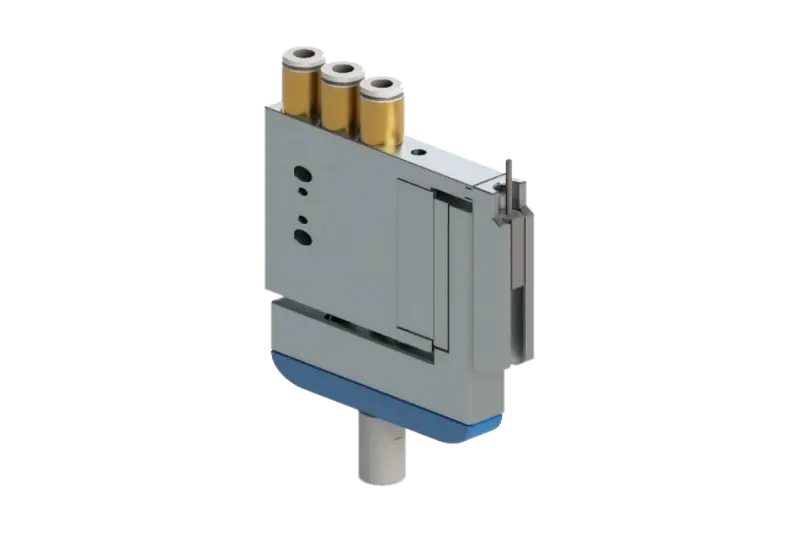
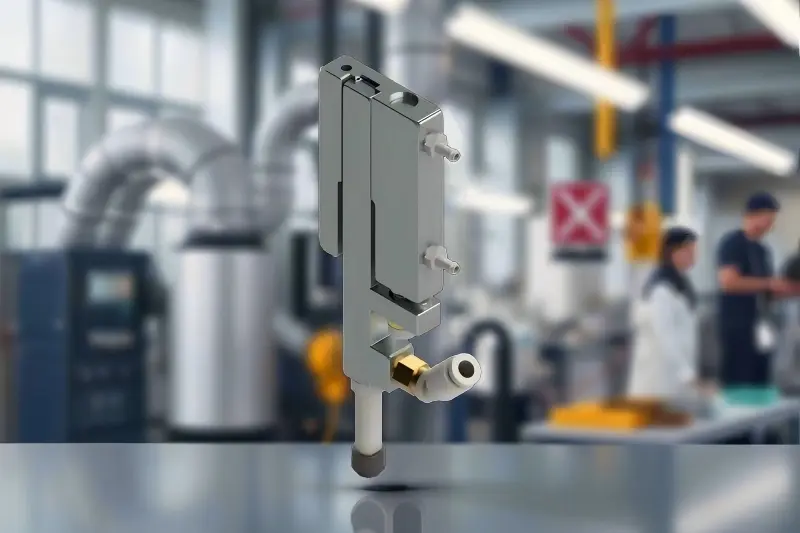
Ultra-thin vacuum cylinder: compact space vacuum suction and high-precision positioning scheme
In the patch, chip sorting, semiconductor flower basket transportation, photovoltaic sheet loading and unloading, medical device assembly and 3C small piece swing plate, the equipment stations are getting denser and denser. There are three types of problems in the traditional cylinder and external vacuum components: the axial thickness of the cylinder body is large, and the narrow sliding table interferes with adjacent mechanisms after stacking; Vacuum tube and signal line are wired separately.
👁 2 · Ultra-thin vacuum cylinder
vacuum cylinder
Special cylinder for semiconductor
 Company News
Multi-station variable-pitch mechanism: High-precision positioning technology for precision synchronous variable-pitch slides and modules.
In modern high-speed automated production lines, multi-station operations impose stringent requirements on the dynamic adjustment of workpiece spacing. From material retrieval and assembly to inspection and sorting, the spacing between workstations in each process often varies. Traditional equidistant conveying struggles to match the takt times and layouts of different equipment, resulting in difficulties in line integration, large floor space requirements, and production…
👁 57 · multi-station variable distance mechanism
Variable pitch slide
Synchronous variable pitch slide
Company News
Special Cylinder for Semiconductor: Technological Breakthrough of Precision Pneumatic Actuating Components in Clean Room
The semiconductor manufacturing environment is extremely sensitive to contaminants, and no more than 1 particle ≥ 0.1 μm per cubic foot in a Class 1 clean room. Traditional industrial cylinders will produce rubber wear particles, lubricating oil volatiles and metal debris during operation, which will directly lead to wafer scrap once they enter the process. At the same time, crystal
👁 119 · Special cylinder for semiconductor
Precision slide cylinder
Ultra-thin vacuum cylinder
 Company News
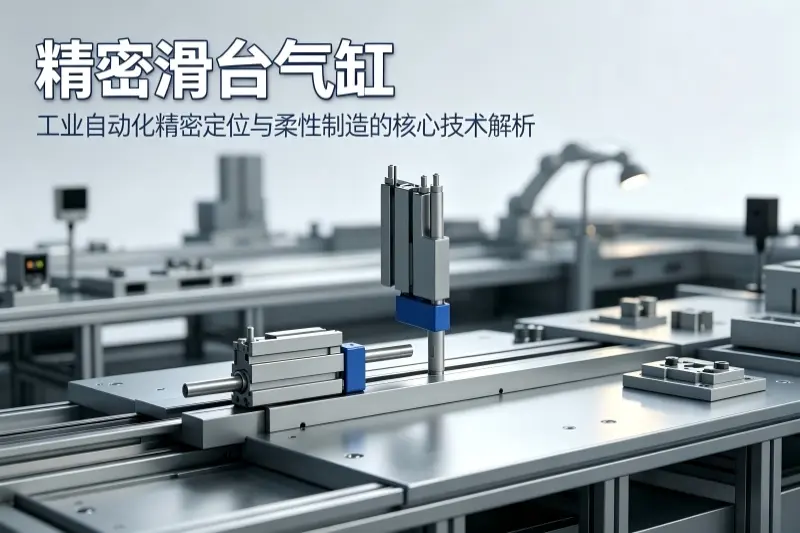
Precision Slide Cylinder: An Analysis of the Core Technologies for Precision Positioning and Flexible Manufacturing in Industrial Automation
In consumer electronics assembly, semiconductor packaging and testing, and power‑battery production lines, every gripping, pressing, and dispensing operation by the actuation unit must not only deliver sufficient thrust but also exhibit exceptionally strong resistance to off‑center loads. Due to the slender piston rod, the traditional standard cylinder cannot bear the lateral moment, which is easy to produce when mounting the suction cup or indenter.
👁 124 · Precision slide cylinder
Ultra-thin vacuum cylinder
Sliding table blade cylinder
 Company News
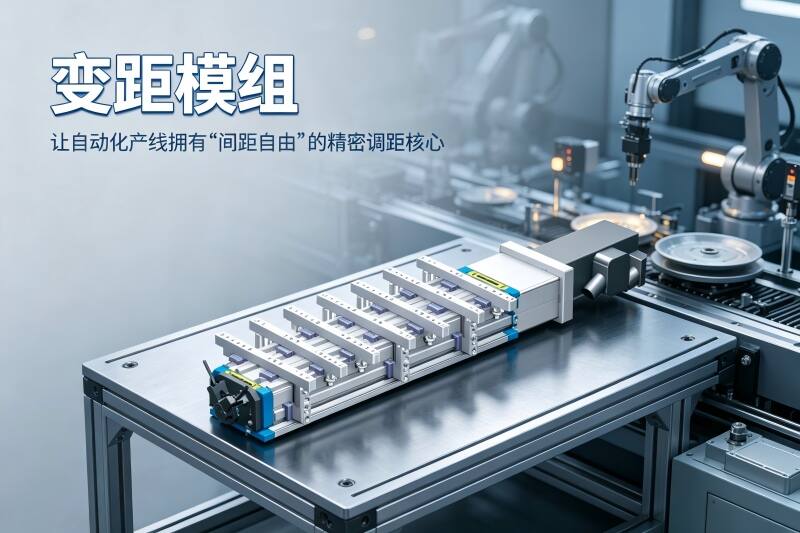
Pitch‑Adjustment Module: The precision‑tuning core that grants automated production lines “pitch freedom.”
A pitch-adjustment module (synchronous pitch-adjustment module/synchronous pitch-adjustment slide) is a precision linear motion mechanism capable of automatically adjusting the spacing between multiple‑station slides in accordance with process requirements. The number of sliders shall not be less than 2, driven by the forward/reverse rotation of the driving shaft, and each slider shall move synchronously and linearly on the precision linear guide rail.
👁 138 · Variable pitch module
Variable pitch slide
synchronous pitch changer
 Company News
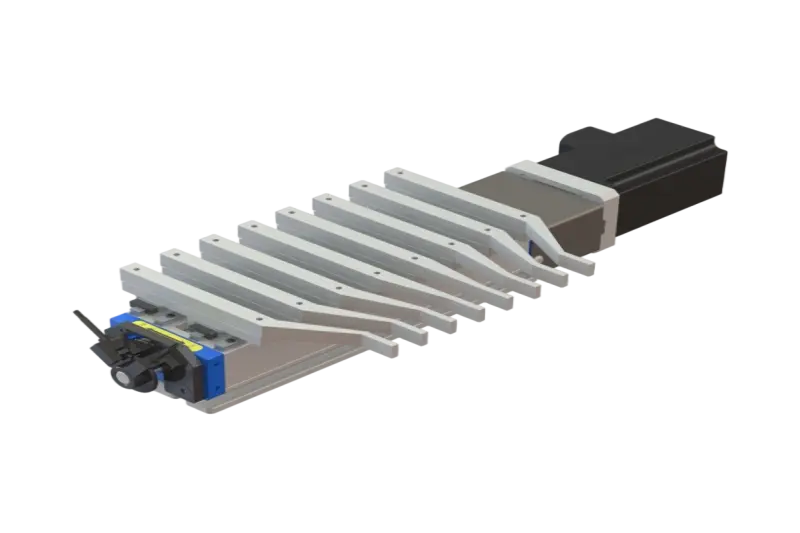
High-Precision Variable-Step Slide Table: Core Module for Automated Multi-Station Synchronized Variable-Step Material Handling
In modern electronics assembly, semiconductor packaging, and new-energy vehicle battery production lines, multi-station synchronous material handling has become a standard process. Conventional fixed‑pitch slides cannot accommodate variations in spacing between workstations, resulting in insufficient equipment flexibility and high changeover costs. The high-precision variable-pitch slide table uses a synchronous belt or lead screw to drive multiple carriage blocks, enabling them to scale their spacing in synchronization according to a preset ratio and thus providing flexible handling capabilities for multiple workpiece spacings with a single machine. According to industry statistics, the adoption of variable‑pitch slides has reduced line changeover times by more than 60% and increased workstation compatibility to 95%. Leveraging more than two decades of expertise in precision motion‑control technology, Xinda Automation’s XD‑series variable‑pitch slide stages are now in stable, long‑term operation at numerous institutes affiliated with the Chinese Academy of Sciences and leading manufacturing enterprises.
👁 96 · High precision variable pitch sliding table
Equidistant variable pitch sliding table
High-speed variable pitch sliding table
 Company News
How to Choose a Reliable Blade Cylinder Manufacturer? A Five‑Dimensional Analysis of Xinda Automation
.xds-wrap{margin:0 auto;padding:50px 22px}/* 文章头部 */.xds-header{text-align:center;margin-bottom:50px
👁 86 ·
Company News
Multi-station variable‑pitch mechanism: the flexible pitch‑adjustment core of automated production lines, enabling precise and highly efficient batch transfer.
The primary bottleneck in modern automated production is often not a lack of speed, but rather fixed workstation spacing, cumbersome changeover and setup procedures, and asynchronous operations across multiple workstations. Conventional assembly-line transplanting typically employs fixed workstations, independent pneumatic cylinders, and split slide tables in coordinated operation. Once the incoming material spacing, processing spacing and wobble plate spacing do not match, it is necessary to manually rectify the fixture, recalibrate the parameters and replace the station accessories. Not only does debugging take time and occupy a large space, but multi-power linkage is also prone to signal delay, position deviation and cumulative error, which frequently leads to the problems of material stuck, position deviation and material drop, seriously dragging down the yield and production capacity of the production line. At the moment when flexible production has become the mainstream, multi-station variable distance mechanism has become the core of non-standard automation. It takes single-power mechanical synchronous transmission as the core, realizes multi-station synchronous opening and closing, automatic pitch adjustment and accurate material separation, does not need complicated electronic control debugging, perfectly solves the problems of batch transplanting, detection and spacing adaptation of multi-specification workpieces, and is the flexible beat center of high-end intelligent production line.
👁 88 · multi-station variable distance mechanism
Variable pitch slide
Variable pitch module
Company News
Slide‑table blade cylinder: the high‑speed, stable pneumatic core for precision cutting at high‑frequency workstations.
In automated applications such as die-cutting, film slitting, wire trimming, label stripping, and small-part punching, standard pneumatic cylinders suffer from poor precision, excessive vibration, and unstable return positioning, often resulting in defects like incomplete cuts, skewed cuts, burrs, and blade sticking. The slide‑table blade cylinder, as a dedicated integrated pneumatic actuator for cutting, incorporates a precision slide‑table guiding mechanism.
👁 70 · Sliding table blade cylinder
Ultra-thin vacuum cylinder
Precision slide cylinder
Company News
Synchronous variable pitch sliding table: the "spacing free artifact" of automatic production line, making multi-station load transfer efficient and accurate.
In the intelligent manufacturing automation production line, the bottleneck of many processes is never that the speed is not fast enough, but that the workpiece spacing is not matched, the station spacing is not uniform, and the material distribution and loading are not synchronized. Traditional multi-station handling, mostly rely on multiple cylinders, modules step-by-step action, step-by-step movement, sub-
👁 74 · Synchronous variable pitch slide
synchronous pitch mechanism
Synchronous pitch module
Company News
Multi-Station Variable-Pitch Module: A precision drive module for synchronous pitch adjustment of multiple workpieces on automated production lines.
In high-end production lines such as those for 3C electronics, new-energy lithium batteries, precision automotive components, and automated sorting and handling, multi-station synchronous operations have long been the cornerstone of efficient mass production. Traditional multi-station handling, grabbing and transplanting operations have long faced a major industry pain point: material reclaim spacing, conveying spacing and tooling positioning spacing do not match each other.
👁 59 · Multi-station variable pitch module
High-speed variable pitch sliding table
Equidistant variable pitch sliding table
Company News
Semiconductor special cylinder: semiconductor automation equipment to achieve precision transfer, precision transmission of the core standard accessories.
In high-end manufacturing processes such as semiconductor wafer processing, photolithography and etching, thin-film deposition, chip packaging, and precision inspection, conventional industrial cylinders suffer from significant particulate emissions, unstable friction, oil exudation from seals, poor positioning accuracy, and strong exhaust-induced turbulence. Conventional pneumatic components are easy to produce wear particles, oil volatile impurities during operation, extremely
👁 51 · Special cylinder for semiconductor
Precision slide cylinder
Ultra-thin vacuum cylinder
