
Multi-station variable‑pitch mechanism: the flexible pitch‑adjustment core of automated production lines, enabling precise and highly efficient batch transfer.
The primary bottleneck in modern automated production is often not a lack of speed, but rather fixed workstation spacing, cumbersome changeover and setup procedures, and asynchronous operations across multiple workstations.
Conventional assembly-line transplanting typically employs fixed workstations, independent pneumatic cylinders, and split slide tables in coordinated operation. Once the incoming material spacing, processing spacing and wobble plate spacing do not match, it is necessary to manually rectify the fixture, recalibrate the parameters and replace the station accessories. Not only does debugging take time and occupy a large space, but multi-power linkage is also prone to signal delay, position deviation and cumulative error, which frequently leads to the problems of material stuck, position deviation and material drop, seriously dragging down the yield and production capacity of the production line.
At the moment when flexible production has become the mainstream, multi-station variable distance mechanism has become the core of non-standard automation. It takes single-power mechanical synchronous transmission as the core, realizes multi-station synchronous opening and closing, automatic pitch adjustment and accurate material separation, does not need complicated electronic control debugging, perfectly solves the problems of batch transplanting, detection and spacing adaptation of multi-specification workpieces, and is the flexible beat center of high-end intelligent production line.
01 What is a multi-station variable distance mechanism?
The multi-station variable pitch mechanism is a precision transmission mechanism specially designed for synchronous load transfer of multiple workpieces and adaptive switching of station spacing. The core logic is single-drive linkage, mechanical synchronization, stepless pitch adjustment and equal division accuracy.
Different from the complicated structure of traditional multi-axis independent control, it relies on cam, screw rod, connecting rod and synchronous transmission structure, and drives multiple station sliding tables, fixtures and clamping jaws to open and close synchronously through a single power source. The whole process is purely mechanical linkage, abandoning the split drive mode of multiple groups of motors and cylinders, and truly realizing gathering and picking, equal distribution of materials, one-key pitch change and synchronous displacement.
Simply put: one set of mechanism replaces multiple sets of transplanting components, no matter how the workpiece specifications change, it can quickly match the corresponding station spacing, making the production line more flexible and more stable in operation.
Why is the traditional fixed station less and less applicable?
The inefficiencies and failures of the old production lines are mostly due to structural solidification, and the three major pain points cannot be adapted to flexible production:
First, the spacing is solidified, and the adaptability is extremely poor: the fixed station can only be adapted to a single specification workpiece, and the product needs to rectify the jig and adjust the machine position when changing the type and size. The change cost is high and the downtime is long.
Second, multi-source drive, serious error accumulation: multi-cylinder, multi-slide independent operation, electronic control signal has millisecond delay, long-term operation shift, inaccurate alignment, frequent card material, yield is difficult to guarantee.
Third, the structure is bloated and the operation and maintenance cost is high: there are many split power components and sensing accessories, the equipment layout is messy, the rack space is large, the later failure points are many, the maintenance is complicated, and the invisible production cost remains high.
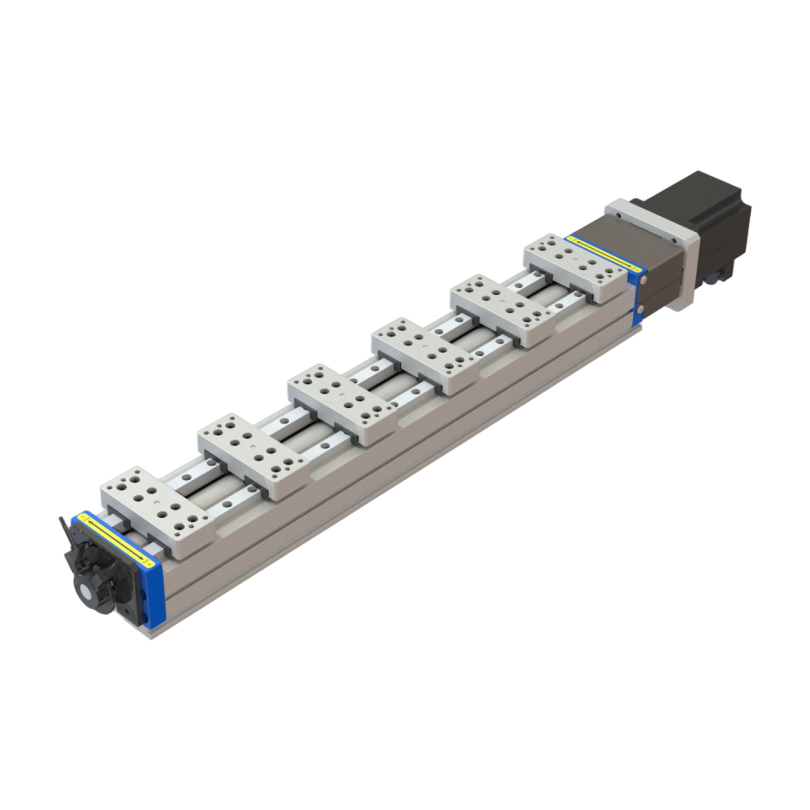
03 Four core advantages of multi-station variable distance mechanism, rolling traditional transplanting structure
As the core component of flexible automation, multi-station variable distance mechanism from the precision, efficiency, cost, adaptability of all-round upgrade, directly hit the industry production pain point.
✅Zero error of mechanical synchronization, highly unified station action
The integrated synchronous transmission design is adopted, the whole mechanical linkage has no signal delay, and multiple stations start and stop synchronously, change pitch synchronously and move load synchronously. Put an end to the problems of position deviation and action lag caused by split drive, with uniform spacing and accurate repeated positioning, solving the problems of workpiece deviation, material stuck, falling and the like from the root cause, and adapting to the production of high-precision precision workpieces.
✅Flexible stepless pitch adjustment, high efficiency and worry-free change
Support to adjust the opening and closing stroke and station spacing on demand, can adapt to multi-specification, multi-size workpiece production, no need to change the fixture, no need for complex programming debugging. Small batch, multi-category flexible change second-level adaptation, completely break the traditional fixed station "one equipment limited to one product" limitations, greatly improve the utilization rate of production lines.
✅Single-drive minimalist structure, space-saving failure.
Single motor, single power drive design, streamline redundant power and electronic control accessories, equipment structure is more compact, greatly saving rack installation space. At the same time, the sensors, cylinders, sliding tables and other wearing parts are reduced, the failure points are greatly reduced, the equipment operation is more stable, and the cost of later operation and maintenance, maintenance and overhaul is significantly reduced.
✅High-speed, stable and durable, suitable for 24-hour mass production
The whole machine adopts high rigidity transmission structure, small running vibration, strong fatigue resistance and low wear. It can be adapted to high-frequency, long-term continuous mass production conditions, high-speed transplanting without deformation, spacing without deviation, long-term operation accuracy without attenuation, perfectly matching the all-weather stable production requirements of modern factories.
04 Mainstream structure classification, adapt to various working conditions as required
According to different load, precision and speed requirements, the multi-station variable pitch mechanism is divided into three types of mainstream structure, accurately matching the production scenario:
Connecting rod type variable pitch mechanism: simple structure, high cost performance, low failure rate, suitable for light load, conventional and equal transplanting scenes, mostly used for ordinary small pieces of batch sorting and swinging.
The screw cam type variable pitch mechanism: high positioning accuracy, strong bearing capacity, stable operation, suitable for medium and heavy load, high-precision working conditions, is the mainstream selection of lithium battery, semiconductor, precision electronics industry.
Synchronous belt type variable distance mechanism: fast running speed, quiet low noise, large stroke range, suitable for high-speed light load scene, widely used in food, packaging, light industrial products fast material transplanting.
05 global adaptation scene, high-end intelligent general just need
With the core characteristics of precision, efficiency, flexibility and stability, the multi-station variable distance mechanism covers multi-industry automated production lines and is the standard core of flexible production:
🔋New energy lithium battery industry: battery core material distribution, pole piece transplanting, battery module spacing adjustment, batch swing plate detection;
💻Semiconductor precision electronics: chips, chip components, micro-precision small pieces of synchronous spacing, transfer positioning;
📦Light industry packaging industry: food, daily necessities, packaging box batch and other sub-feeding, sorting, regular plate;
🚗Auto parts industry: precision parts, plastic structural parts multi-station synchronous transplanting, assembly positioning;
🏥Medical beauty industry: reagent accessories, beauty small pieces of high-precision variable transplanting, batch testing.
Written at the end
The upgrade of intelligent manufacturing has never been a simple speed increase, but a double upgrade of structural flexibility and precision stability.
The multi-station variable pitch mechanism breaks the production limitation of the traditional fixed station with the advantages of synchronous zero error, flexible adjustable, simple and stable operation, long-lasting and durable hard core. With a set of precision linkage structure, adapt to thousands of working conditions, simplify the production line structure, improve production efficiency, reduce production costs, and continue to empower modern flexible intelligence.
A mechanism to control multi-station, precise distance stable beat, with flexible precision strength, unlock efficient mass production of new potential energy.

李工 / Senior Mechanical Engineer
With 12 years of experience in the R&D of automation equipment and precision transmission components, the company specializes in the design of variable-pitch slides, vacuum cylinders, and precision linear shaft assemblies. Has participated in numerous non-standard automation projects across the 3C, semiconductor, and new-energy industries, with a strong understanding of high-precision machining processes as well as assembly and commissioning.


