
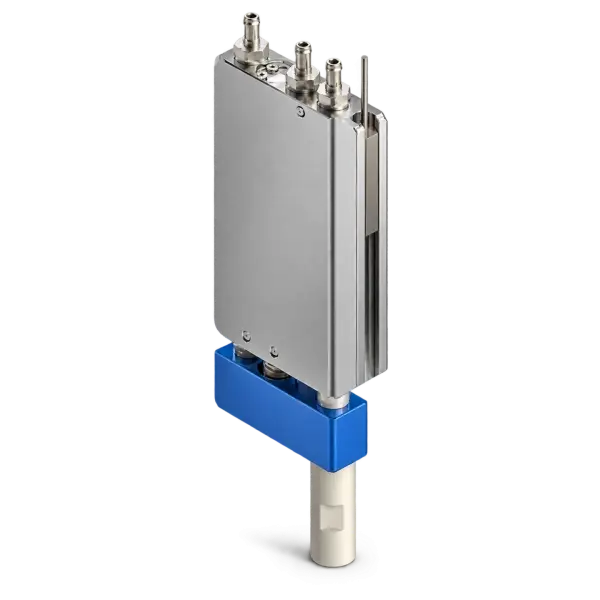
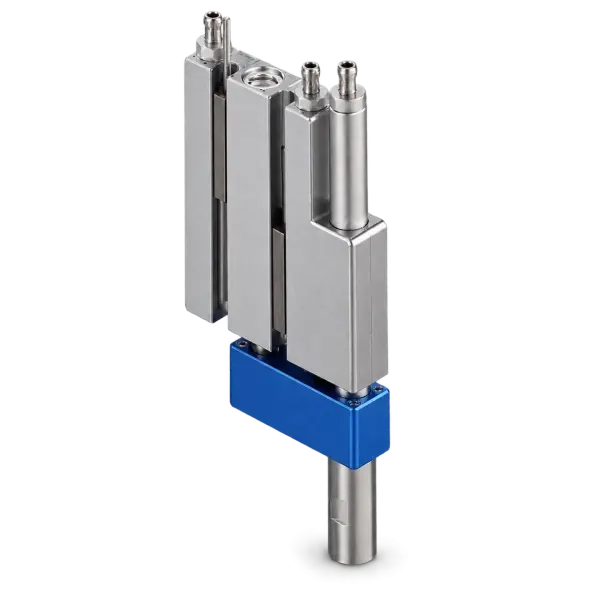
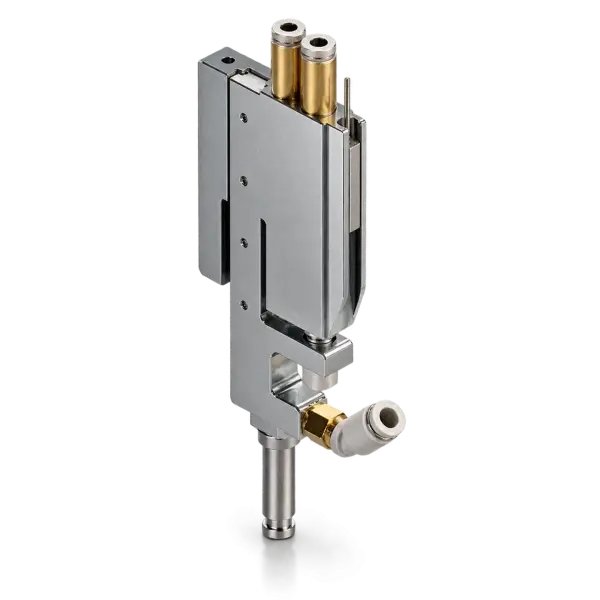
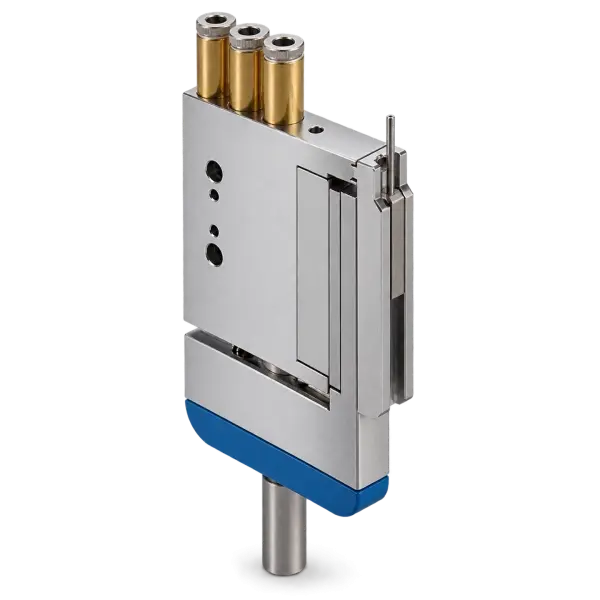
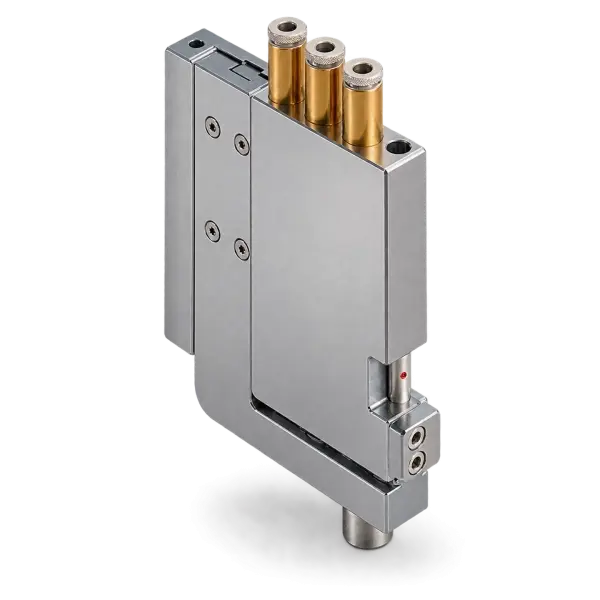
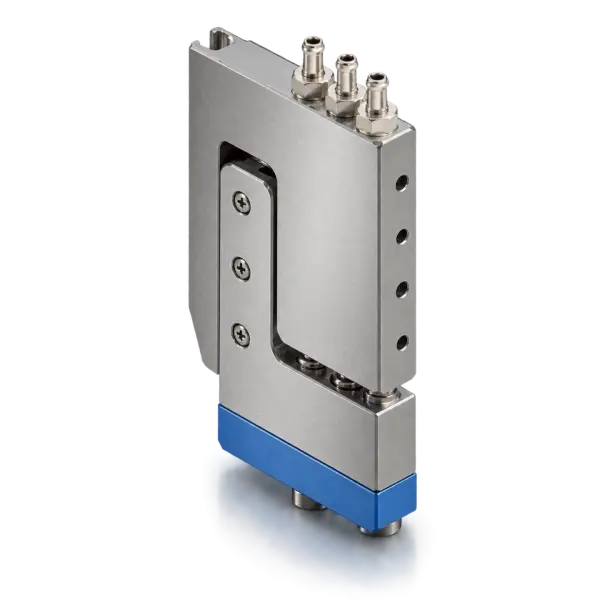

Sliding table type blade cylinder
The ultra-thin cylinder body and precision linear guide rail are integrated into one, the thickness of the body is close to that of the traditional blade cylinder, but it can directly bear the load and partial load moment without external guide rail-it is designed for the working condition with limited space but requiring high precision guidance.
WHAT IS IT
What is a sliding table type blade cylinder
Blade cylinderIt is named after the thin cross-section of the cylinder body such as a blade. It is mainly used for occasions where the axial installation space is strictly limited, such as the internal of the clamp, the dense arrangement of multiple rows, and the pressing of narrow slits.
But the traditional thin cylinder has an inherent short board:Weak anti-biased load capacityOnce the load exists eccentric or lateral force, piston rod and cylinder wall direct friction, will quickly lead to seal wear, action stuck or even leakage. The usual solution in engineering is to hang a set of linear guides-but in this way, the space advantage is gone.
Sliding table type blade cylinderThe solution is to put the precision linear guideBuilt-inTo the inside of the cylinder body: the cylinder body is not only the air chamber, but also the guide rail installation reference; the slider is directly used as the load installation surface. The thickness increase of the whole machine is extremely limited, but it has obtained a complete guiding capacity-load, bending moment and partial load are all borne by the built-in guide rail, and the cylinder is only responsible for providing thrust.
ADVANTAGES
Compared with ordinary thin cylinders, what is the difference?
The following table compares differences based on structural principles for selection reference. The specific value is subject to the specification.
01
Save external guide rail
Rail built-in, no need to purchase, install, debug external linear guide. Save costs, but also save installation space and assembly man-hours.
02
Direct resistance to eccentric load
The bending moment generated by the load is borne by the guide rail, and the piston rod only bears the pure axial force, which fundamentally avoids the early failure caused by eccentric wear.
03
Body is still thin
Under the premise of retaining the advantage of the thickness of the blade cylinder, the guiding ability is obtained, and it is suitable for the narrow working conditions such as the inside of the clamp and the dense arrangement of multiple rows.
04
Rigid Grading
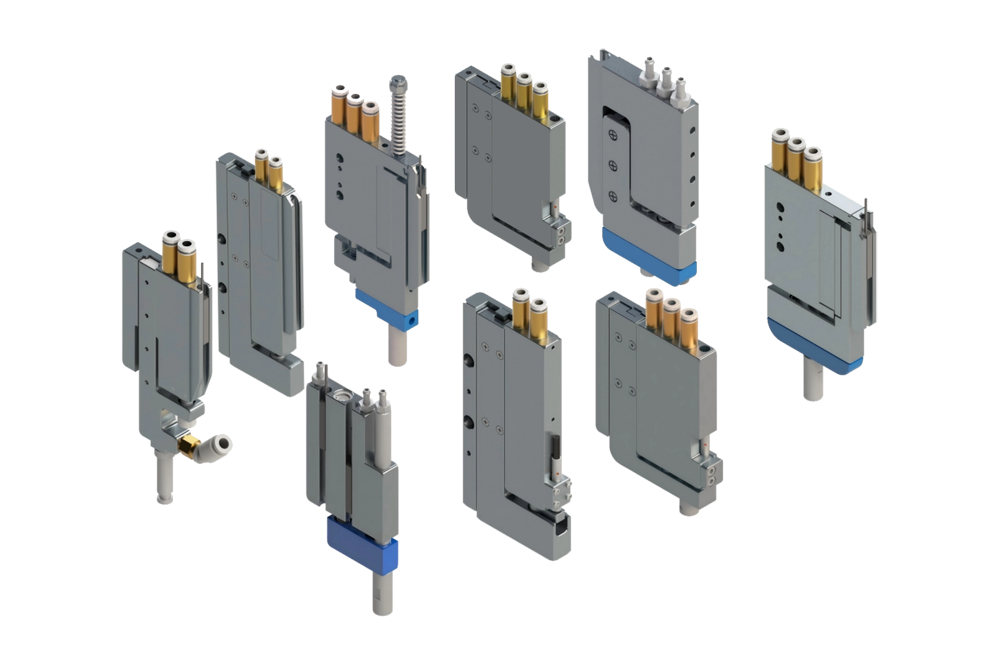
Provide 4 guide configurations, from economical guide rod type to cross-ball composite guide, according to actual accuracy requirements, do not pay for excess performance.
| Comparison item | Sliding table type blade cylinder | Ordinary thin cylinder | Slim cylinder external guide rail |
|---|---|---|---|
| Overall thickness | thin | Thinnest | Thicker |
| Anti-eccentric load/anti-bending moment | Strong | Weak, need to avoid lateral force | Strong |
| Installation Work | Low | Low | High (required for parallelism) |
| Total cost | middle | Low | High (cylinder guide rail assembly) |
| Applicable working conditions | Limited space with load/eccentric load | Pure axial push, no lateral force | Plenty of space and high precision |
Objective description: if the working condition isPure axial push, completely no lateral force, The cost of ordinary thin cylinders is lower, and the sliding table type is not necessary. We would rather help you to stop the inappropriate selection than see problems after installation.
KEY SELECTION
How to choose among the four guidance methods?
The guiding method directly determines the cylinder’s precision, rigidity, load capacity, and price. Choosing the wrong guidance method is more critical than selecting the wrong cylinder bore.
| Guidance mode | Structural features | Accuracy class | Rigidity | Cost | Applicable working conditions |
|---|---|---|---|---|---|
| Guide rod type | Two quenched guide rods with sliding/ball bushings—the simplest design. | Generally | middle | Low | Push/pause applications with low positioning accuracy requirements, slow cycle times, and budget sensitivity. |
| gothic linear guide | Arc-shaped groove (Gothic tooth profile) with two-point contact; it automatically centers under load, offering high rigidity and low friction. | High | High | middle | The mainstream choice: multi-station pick-and-place, precision positioning, and applications requiring a faster cycle time. |
| cross ball guide | The rollers are arranged in a 90° crossed configuration, ensuring uniform load distribution in all directions and minimizing deformation. | Very high | Very high | Higher | High-precision detection, micrometer-level repeat positioning accuracy, with overturning moment. |
| Crossed roller guide rail, rod-guided | Composite guidance: the guide rod provides coarse guidance, while crossed roller bearings ensure final precision. | Highest | Highest | High | Coexistence of heavy load and high precision, long-stroke cantilever, and large eccentric load conditions. |
Selection formulaFirst, check whether there are lateral forces or eccentric loads. If not, a guide rod design is the most cost-effective; if there is an eccentric load, opt for a Gothic‑style design. For micron‑level precision or when overturning moments are present, choose crossed‑roller guides. Only when both heavy loads and high precision are required should you consider a combined guidance system.
PRODUCTS
Recommended Best-Selling Models
The following are standard stock models, covering four types of guidance. Each card provides direct access to the detailed specifications and drawing downloads for that model.
Best-selling
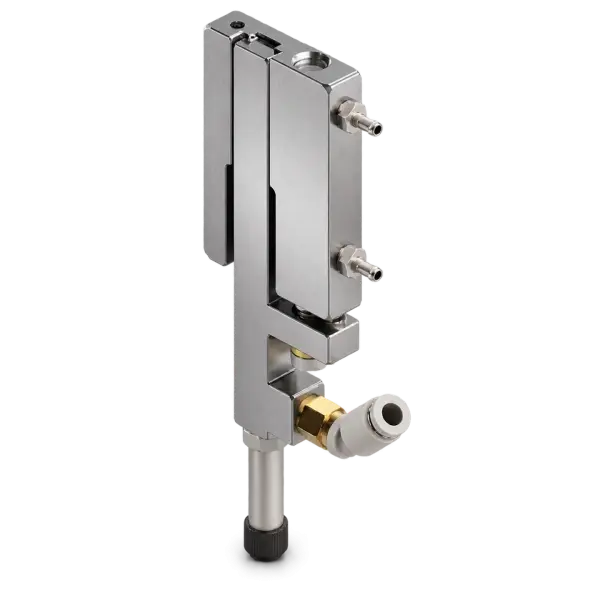 XD 0806A-L
XD 0806A-L
Re-action
View parameters
Best-selling
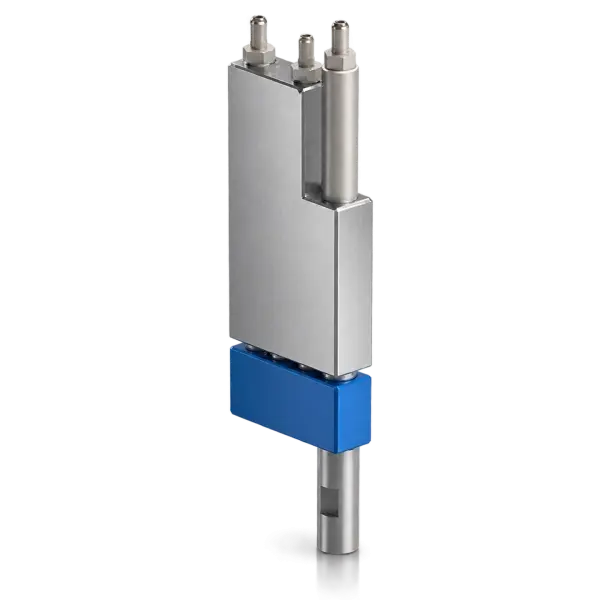 XD 0806-L
XD 0806-L
Re-action
View parameters
| General Specification Items | Description | General Specification Items | Description |
|---|---|---|---|
| Use of fluids | Clean compressed air | Surface treatment | cylinder block semi-hard oxidation |
| Bore range | Customizable | Repeatability positioning accuracy | Customizable |
| Standard itinerary | Customizable | Allow load | Customizable |
| Operating pressure range | Customizable | Allowable bending moment | Customizable |
| Operating speed range | Customizable/s | Operating temperature range | Customizable °C |
| Buffering form | Customizable | Interface thread/Lubrication | Customizable |
For detailed specifications, please refer to the specific model page.
MODEL LIST
Overview of Standard Models
The model numbers and guidance methods in the table are based on actual data from the Product Center.For detailed specifications, please refer to the specific model page.。
| Serial Number | Product Name | Guidance mode | Thickness | Itinerary | Cylinder bore | Surface treatment | Types of exercise | 3D model download | View Details |
|---|---|---|---|---|---|---|---|---|---|
| 1 | XD 0806C-L-S | gothic linear guide | 8 | 10/15/20 | 6 | semi-hard oxidation | Re-action | 3D model | View Details |
| 2 | XD 0806-L-S | Guide rod type | 8 | 10/15/20 | 6 | semi-hard oxidation | Re-action | 3D model | View Details |
| 3 | XD 0806B-L-S | gothic linear guide | 8 | 10/15/20 | 6 | semi-hard oxidation | Re-action | 3D model | View Details |
| 4 | XD 7.706A-L-S | cross ball guide | 7.7 | 10/15 | 6 | semi-hard oxidation | Re-action | 3D model | View Details |
| 5 | XD 0806A-L | gothic linear guide | 8 | 15/20/30 | 6 | semi-hard oxidation | Re-action | 3D model | View Details |
| 6 | XD 0806-L | gothic linear guide | 8 | 10/15/20 | 6 | semi-hard oxidation | Re-action | 3D model | View Details |
| 7 | XD 1008-L-S | gothic linear guide | 10 | 15/20 | 8 | semi-hard oxidation | Re-action | 3D model | View Details |
| 8 | XD 6.505-L10-S | gothic linear guide | 6.5 | 10 | 5 | semi-hard oxidation | Re-action | 3D model | View Details |
| 9 | XD 1008-50-C | gothic linear guide | 10 | 50 | 8 | semi-hard oxidation | Re-action | 3D model | View Details |
| 10 | XD 1008-l-c-g | gothic linear guide | 10 | 15/20/30 | 8 | semi-hard oxidation | Re-action | 3D model | View Details |
| 11 | XD 1008-50-S | gothic linear guide | 10 | 50 | 8 | semi-hard oxidation | Re-action | 3D model | View Details |
| 12 | XD 1008-L-C | gothic linear guide | 10 | 15/20 | 8 | semi-hard oxidation | Re-action | 3D model | View Details |
| 13 | XD 7.706B-L-S | Cross ball guide guide guide | 7.7 | 15/20/30 | 6 | semi-hard oxidation | Re-action | 3D model | View Details |
Refer to the specific model page for the model naming rules.
HOW TO SELECT
The Four-Step Selection Method
Please provide the operating condition parameters; we can assist with model confirmation and drawing verification.
-
Calculate the thrust and include a margin.
First, calculate the actual required thrust (workpiece weight + friction force + acceleration force), then divide it by the theoretical output force under the working pressure.
Required thrust F = (workpiece weight + friction force + acceleration force) × safety factor (recommended 1.5–2)Pressure fluctuations in pneumatic systems are common.Do not calculate based on full pressure.. If the actual supply pressure is too low, be sure to verify it against the minimum pressure requirement.
-
Determine whether there is a lateral force or an eccentric load.
This is a crucial step in determining the guiding approach.
- Pure axial thrust, no lateral force → a guide rod type is sufficient.
- For eccentric loads and cantilever mounting, use at least a Gothic-style linear guide.
- When there is a overturning moment and micrometer-level repeat positioning is required → crossed roller linear guide
- Coexistence of heavy load and high precision → Crossed roller and linear guide composite guidance
-
Confirm dimension constraints
Verify the following three points: axial usable thickness, stroke requirements, and whether the slider mounting hole positions are compatible with the existing fixture.
AttentionThe longer the travel distance, the greater the bending moment under cantilever conditions. If the stroke is close to its upper limit and the load is significantly eccentric, it is recommended to increase the guide configuration by one level.
-
Confirm operating conditions and environment.
Pulse frequency (whether buffering is required), air source cleanliness, ambient temperature, presence of dust or cutting fluid, and whether an inductive switch feedback is needed.
These factors directly determine whether to select a cushioned type, a special seal, a protective cover, or an additional magnetic switch.
APPLICATIONS
Typical Application Scenarios
The following are common application areas for blade cylinders. It is recommended to include one real-life or illustrative image for each scene.
3C and Semiconductors
- Multi-station pick-and-place for phone cases and middle frames.
- Chip tray transfer and loading
- Screen lamination alignment and pressure retention
- Precision pressing of lead frames
Lithium batteries and new energy
- Cell sorting and transfer
- Battery electrode slitting and calendering
- Module stacking positioning
- Multi-column dense arrangement clamping
Inside the fixture
- Pushing within the constrained internal space of the fixture.
- Narrow-gap clamping and ejection
- Multi-station synchronous clamping
- Positioning stop and material separation
Precision measurement
- Stage drive for image measuring machines and projectors
- Tool microscope, tool setter feed
- Multi-probe simultaneous localization
- Loading and unloading at the inspection station
Healthcare and Packaging
- Medical consumable assembly and pressing
- Reagent kit sorting and transfer
- Packaging machine sealing and pressing
- Labeling and Coding Positioning
Research and Automation Production Line
- Precision feed of the experimental apparatus
- Non-standard customization for research institutions
- General-purpose automated assembly line
- Robotic end effector
AttentionDon’t list industries you haven’t worked in. If you write it down but there’s no corresponding case, you’ll actually lose points if the client follows up and asks about it. First, focus on the 3 to 4 industries where you’ve actually delivered results—going deep is more effective than going wide.
FAQ
FAQ
Can a blade cylinder withstand lateral forces?
Standard thin-type cylinders are not recommended for withstanding lateral loads; prolonged eccentric loading can lead to uneven wear between the piston rod and cylinder bore, premature seal failure, and sticking during operation.
The slide-type blade cylinder accommodates lateral forces and bending moments through its built-in linear guide, while the piston rod only bears pure axial thrust.Therefore, it can be used under conditions of eccentric loading. However, please note that each guidance method has its own maximum allowable load and bending moment; be sure to verify the parameter table during selection.Even when the allowable bending moment is exceeded, additional independent guide rails are still required for support.。
How should it be paired with the zoom module?
The two are in a complementary relationship rather than a substitutive one.The pitch-adjustment module is responsible for changing the spacing between workstations, while the blade cylinder handles the pick-and-place/pushing actions at each workstation.A typical configuration is “variable‑pitch module, multiple blade cylinders, and vacuum grippers.” We offer dedicated variable-pitch modules for blade cylinders (XD 5355C, XD 685C, XD 8577C), which come with pre‑installed mounting interfaces for direct compatibility, eliminating the need to design and fabricate adapter plates yourself. See detailsVariable Pitch Module Product Page。
How significant are the differences in accuracy among the four guidance methods?
From lowest to highest in terms of precision and rigidity: guide rod type → V‑rail linear guideway → crossed roller guideway → combined guide rod–crossed roller guidance. For specific repeatability positioning accuracy values, please refer to the specification sheets for each model, or contact the technical department to request measured data. When selecting components, there is no need to blindly pursue the highest precision—With each increase in accuracy grade, the cost rises significantly.Selecting the model based on actual needs is the most cost-effective approach.
Do you support non-standard customization? How long does it take?
Support. Common customization options include: special stroke, customized mounting hole positions, special sealing materials (high-temperature resistant/chemical-resistant), addition of proximity switches, custom air inlet orientation, stainless steel housing, and more. The customization lead time depends on the extent of the modifications.Please provide the operating condition parameters and the drawings; we will then provide a specific delivery date.。
What do the model suffixes -S / -C / -G stand for?
Without the "S" suffix, it is the non-magnetic version. Example: XD 806-10/15/20-S. Please refer to the specific model description page for the model naming rules.
Can it be equipped with a magnetic switch? How is the sensitivity ensured?
CustomizablePlease confirm: which models come standard with a magnetic switch slot, which require it as an optional feature, the available model options (such as D-C73/D-Z73, etc.), as well as the installation location and adjustment method. It is recommended to include an installation diagram.
Does the cylinder require lubrication? What are the requirements for the air supply?
CustomizablePlease specify: whether the design is oil-free, whether an oil mist lubricator is recommended, the required filtration accuracy of the air supply (generally recommended to be 5 μm or less), and whether drying treatment is necessary. These factors directly affect service life and are frequent concerns for customers.
Need help with selection?
Please provide the operating condition parameters, and we will assist you with model confirmation and drawing verification.
Download the Selection Guide (PDF) Submit operating condition parameters Phone consultation: 13686286625