How to choose a non-uniform pitch module: servo-driven variable-pitch screw, cam linkage, multi-station non-uniform positioning, and blade cylinder coordination.
Dongguan Xinda Industrial Automation Co., Ltd. focuses on the 3C electronics, semiconductor packaging, new-energy battery assembly, medical packaging, and automated sorting‑line sectors, offering coordinated solutions that include precision variable‑pitch slides, multi‑station variable‑pitch modules, blade cylinders, ultra‑thin vacuum cylinders, and rotary vacuum cylinders. These solutions address key challenges in flexible production lines, such as the inability of fixed‑pitch modules to accommodate irregular component arrangements, slow changeovers between mixed product lines, fixed nozzle spacing, and excessive cumulative tolerances.
unequal pitch moduledefinition and principle
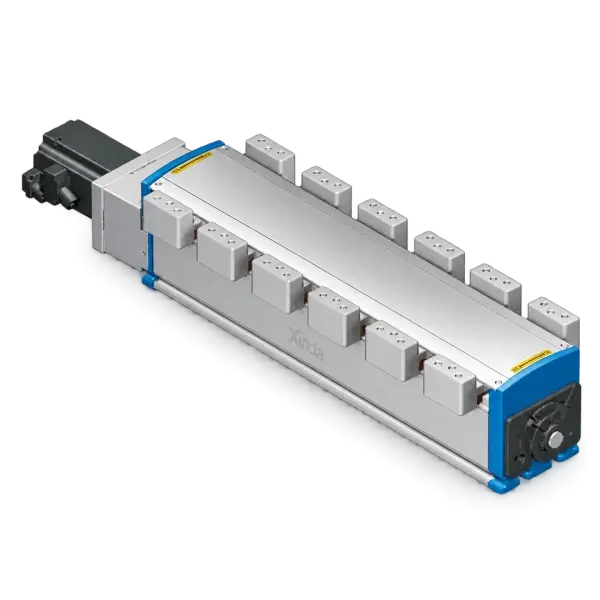
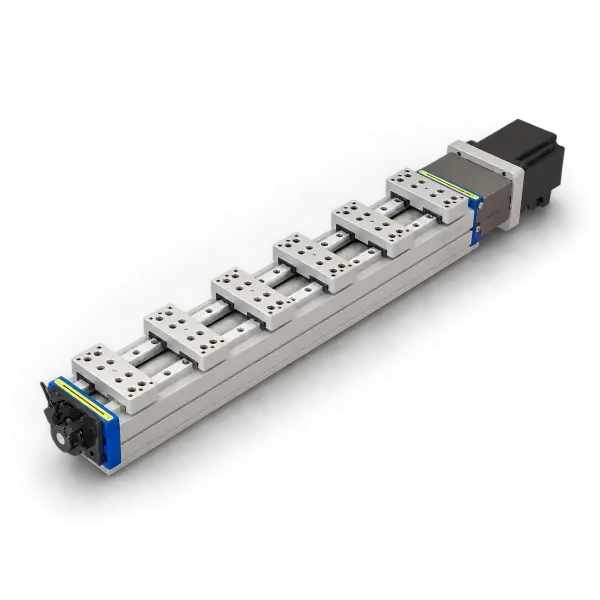
Non-uniform pitch modules are a type of multi-station variable-pitch mechanism: during a single pick-and-place operation, the multiple sliders do not extend in synchrony with equal increments; instead, they are configured according to preset parameters to create a non-uniform distribution of end‑position spacing across the stations, thereby accommodating scenarios where the incoming‑part pitch differs from the outgoing‑part pitch. It typically consists of a drive unit, a variable-pitch transmission component, linear guide rails, a slider assembly, and an end-effector interface; the end effector is equipped with a vacuum suction cup, grippers, or a blade cylinder to perform operations such as picking up parts at non-standard intervals, translating them, and placing them down at non-standard intervals.
Mainstream drive systems fall into two categories: servo and stepper. Variable-pitch lead screws are well-suited for programmatic format changes, with the controller precisely calculating the displacement of each slide. Camshaft linkage, on the other hand, relies on cam profiles to define the slide trajectories; driven by a single motor, it offers excellent synchronization and is ideal for high-speed, repetitive operations involving a fixed set of non-uniform configurations. Standard linear stages can only perform fixed-stroke reciprocating motion. In equidistant‑spacing modules, each station opens and closes proportionally; the challenge with non‑equidistant modules lies in managing cumulative tolerances and ensuring independent guidance for each slider.
Difference between non-uniform and uniform pitch modules
| Dimension | Equal-pitch variable-pitch module | unequal pitch module |
|---|---|---|
| Slider spacing pattern | Increase or decrease each workstation proportionally. | The end-point spacing for each workstation can be set independently. |
| Typical incoming material | Tray array, regular cell arrangement | Irregular parts, mixed-specification carrier trays, asymmetric fixtures |
| Drive method | The lead screw and connecting rod can be synchronized. | Servo independent point positioning or cam curve optimization |
| Production flexibility | High-speed repetition of a single product is more cost-effective. | The advantages of mixed-line production with multiple specifications are significant. |
| Structural difficulties | Guidance rigidity, dustproof | Cumulative tolerance, slider independent guidance, calibration |
| Applicable Scenarios | Batteries spaced at equal intervals, chip array | Phone frame, reagent tube rack, variable-distance tray |
It’s not that “unequal spacing is always better”: when the product range is limited and the cycle time is extremely short, an equal‑spacing synchronous module is more cost‑effective; unequal spacing becomes a must‑have only when the distances between the material‑in position, the processing stations, and the unloading fixtures are inconsistent.
Core Structure and Component Functions
Driver unit
Servo motors offer the smoothest positioning control; stepper motors provide a balanced cost-performance ratio; cam‑type single‑motor mechanical linkage—choose based on changeover frequency.
Variable-pitch screw/cam
A bi-directional lead screw or a segmented variable-pitch screw is used for electric pitch adjustment; the camshaft determines the slide’s opening and closing motion profile.
Linear guide rail
The slider guide assembly’s rigidity directly affects whether the non-equal‑pitch end position drifts; for high‑frequency stations, check the dust cover.
Slider group
Common workstation configurations are 4, 8, or 12; for non-equal spacing, the load on each slider and the eccentric moment must be verified—do not rely solely on the total weight.
Induction switch
NPN/PNP origin and limit signals; the servo can be equipped with an encoder or grating for closed-loop correction.
End interface
Suction nozzle rod, sponge suction cup, gripper fingers, and blade cylinder adapter plate; the Xinda variable-pitch module can be paired with these actuator components.
Non-uniform motion chain:Close and pick up material → Move the entire assembly horizontally above the target workstation → Extend each slide block according to non-uniform parameters → Release vacuum/clamps → Return to zero and close. The key is not simply being able to open, but ensuring that after unfolding, the center of each suction nozzle aligns with the corresponding fixture hole; otherwise, it’s a cumulative tolerance issue.
Typical Application Scenarios
3C electronics tray arrangement
Connectors and FPC boards are transferred from large-pitch carriers to small-pitch packaging trays; multi-specification smartphone components are picked and placed on mixed‑specification lines.
Semiconductor/chip sorting
When the pitch between wafer rings, dies, and test sockets varies, a pitch-adjusting module is paired with an ultra-thin vacuum cylinder for clean handling.
Lithium battery cell transfer
Cylindrical/soft-packed battery tray is taken out at large spacing → asymmetrical folding → module loading; Ear alignment sees repeated positioning.
Medical bottle rack material
试剂管、西林瓶、培养管节距不等,移液或灌装前做异距阵列重排。
包装分拣
瓶罐、盒体多规格装箱,抓取间距随来料排布切换,减少换夹具停机。
汽车零件装配
火花塞、活塞多工位拧紧/检测,双枪或多夹爪间距非等距布置。
Selection formulas and installation specifications
不等距变距模组选型顺序:①列工位数量与各取料/放料中心距;②算单滑块负载+吸嘴/夹爪重量;③定驱动(伺服换规多/凸轮固定形态);④选导轨刚性、变距螺杆导程、电机扭矩;⑤核最小/最大中心距与模组行程;⑥末端执行件(真空/刀片气缸)出转接;⑦打样跑合测各点位重复定位。
不等距别只看“最大展开”:要逐点测中间位是否飘,尤其两端滑块偏心最大。
工位数多时累积公差靠预压螺母、导轨预压和装配标定消化,不是单靠电机分辨率。
吸真空取放要配真空发生器/防掉阀;刀片气缸做推切时核侧向力是否传给滑块。
安装面平面度建议≤0.05mm,吊装/平装/侧装方向先定再选型号。
气动变距适合固定几档间距;需任意点位切换优先伺服。
重复定位精度以出厂实测或打样报告为准,样本静态值不等同动态产线值。
欣达不等距变距模组能力
东莞市欣达工业自动化有限公司2000年从日本、德国引进核心传动技术,主营精密变距滑台、变距模组、一体式微型滑台、刀片气缸、旋转真空气缸及气源处理件,服务3C电子、半导体、新能源电池、医疗器械、包装机械等领域,产品销往台湾、韩国、德国及东南亚。
欣达变距模组支持同步等距与同步不等距作业,不等距形态包含定位点向偏心点、单边偏移、全非均匀排布等;参数按最小中心距、最大中心距、工位数、变距原点、伺服/步进、NPN/PNP、吊装/平装/侧装选定。 重复定位精度参考±0.02mm,实际以订购型号规格书与实测为准。 变距模组可配套真空吸嘴杆、夹爪与刀片气缸转接,非标定制按工位图、负载、节拍与安装空间出方案。

李工 / Senior Mechanical Engineer
With 12 years of experience in the R&D of automation equipment and precision transmission components, the company specializes in the design of variable-pitch slides, vacuum cylinders, and precision linear shaft assemblies. Has participated in numerous non-standard automation projects across the 3C, semiconductor, and new-energy industries, with a strong understanding of high-precision machining processes as well as assembly and commissioning.